
Most people do not do enough exercise to ever need to worry about overtraining. The focus should be on how to move more and exercise more consistently. However, plenty of people eventually reach the opposite problem.
They become highly motivated or just love training and end up doing too much. This often results in injury or overtraining, which is the point where your body simply cannot recover from everything you are asking it to do. Here are some things to consider around this issue.
Exercise + Recovery = Results – You do not actually get fitter while you are exercising. Exercise provides the stimulus. It is during the hours and days afterwards that your body recovers and adapts to that stimulus.
When you exercise, you temporarily make yourself worse. After a hard run your legs may feel heavy and you will probably run slower the next day. After a tough weights session your muscles are weaker and sore. This temporary reduction in performance is completely normal.
Over the following hours and days your body adapts. Aerobic training improves mitochondria, hypertrophy training creates new muscle tissue and strength training improves the neural pathways involved in producing force. You then provide another stimulus and repeat the process.
Training → Fatigue → Recovery → Adaptation
The difficulty is knowing the right amount of training to do to create enough stimulus while still allowing your body to recover from it.
More Training Isn’t Always Better – It is very easy to become a prisoner of what other people are doing. Someone runs 80km a week, so you think you should. Someone trains six days a week, so your four sessions suddenly don’t seem enough. Social media doesn’t exactly help with this.
However, the stimulus you need to initiate fitness gains and the amount of training you can recover from are very individual. One person may thrive on a workload that completely destroys someone else.
Advanced athletes sometimes deliberately use periods of very high training called overreaching. They push themselves through several weeks of high volume or intensity, accumulating lots of fatigue. Training feels difficult and performance may temporarily decline. They then reduce their training and ideally come back feeling fantastic and performing better than before.
The important part is the recovery afterwards. If you continually ask your body to do more than it can recover from, eventually your performance will underwhelm. This means, for all the work you are putting in, you are not getting the returns in performance you would expect.
How Do You Know If You Are Recovering? – You do not need a laboratory to tell you how your body is coping. Your body normally gives you plenty of clues.
An early sign can simply be inconsistent training. Sessions that should feel comfortable suddenly feel difficult. You take longer to recover and increasingly have days where you just feel flat.
As things progress, little injuries and niggles can appear and refuse to disappear. Fatigue starts carrying over into everyday life, motivation to exercise drops and you may notice changes in your sleep and mood or find yourself getting ill more frequently.
Eventually your actual performance starts declining or you simply stop progressing despite doing enormous amounts of training. One terrible workout does not mean you are overtraining. Performance naturally varies from day to day. It is the pattern over time that matters.
Recovery Isn’t Just Having A Day Off – The first recovery tool to look at is your actual training. You cannot recover if you are continually overtraining. You can change various elements of your plan including total workload, the frequency of your hard workouts or volume of specific sessions. You should make use of rest, easier days and easy weeks.
There are then countless recovery methods you can add which really help too. Sports massage, foam rolling, stretching, mobility work, saunas, cold water and compression equipment can all have a place. However, none of them will rescue a training programme that continually asks your body to do more than it can recover from.
Sleep is perhaps the most powerful recovery tool available. The harder and more frequently you train, the more important good sleep becomes. Consistently training hard while sleeping badly simply gives your body another stress it has to absorb.
You Also Need To Eat Enough – Your food intake has to fuel both your training and the adaptations that follow it. This becomes increasingly important as training volume rises. The first priority is simply consuming enough energy. Trying to perform large amounts of exercise while continually under-eating makes recovery much harder.
At the extreme end, athletes can develop Relative Energy Deficiency in Sport (RED-S), where there isn’t enough energy coming into the body to support both training and normal physiological functions. When there isn’t enough energy to go round then something must pay the price. This can show itself through poor performance, lack of recovery or problems with your health. This can affect bone health, hormones, immunity and mental wellbeing. In women, disruption or loss of the menstrual cycle can be an important warning sign.
You also need enough protein to repair and build tissue alongside enough carbohydrates and fats to support your training and general health.
Sometimes You Need To Do Less – Highly motivated people often find this surprisingly difficult. If you have dug yourself into a significant hole, the answer isn’t another supplement, massage gun or motivational speech. You may simply need to reduce your training. In more extreme cases, you may need a complete break for a period of time before gradually building your training back up. This doesn’t mean every time you feel tired you should stop exercising. Feeling tired after hard training is part of the process. The skill is recognising the difference between normal training fatigue that you recover from and continually digging yourself into a deeper hole.
What Does This Mean For You?
Most people should probably worry more about doing enough exercise than doing too much. However, once you are training regularly, recovery becomes increasingly important. Don’t judge your training purely by how many sessions you complete, how many kilometres you run or how exhausted you can make yourself.
Ask whether your body is actually adapting to what you are doing.
If you are getting fitter, stronger, performing well and generally feeling good, your body is probably coping with your training. If your performance is going backwards, you’re constantly tired, every session feels difficult and little niggles won’t disappear, doing even more exercise is unlikely to be the answer.
Give your body a stimulus, allow it to recover and then gradually increase the challenge over time. That is how you actually get fitter.
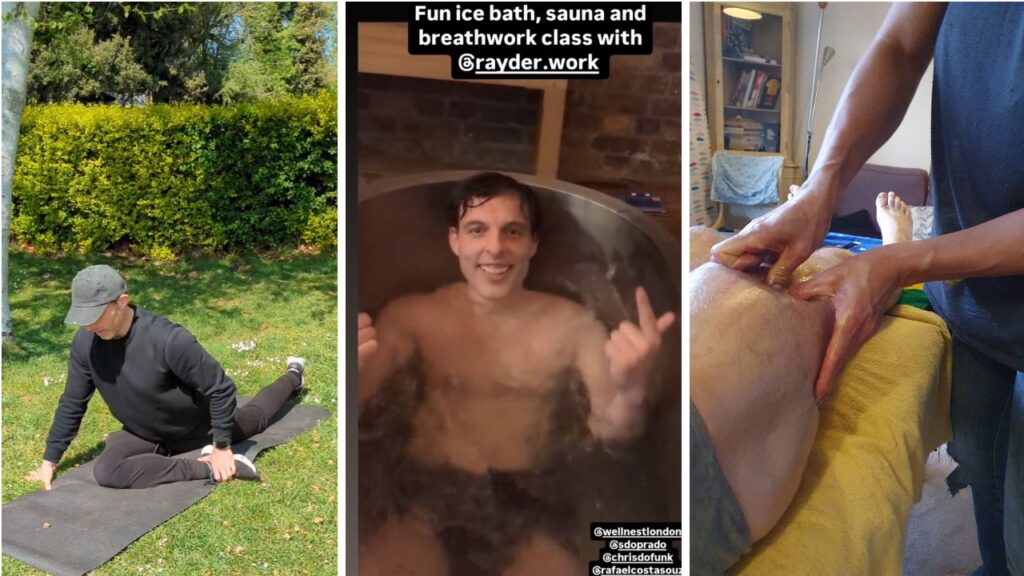
Photo – Me using some recovery techniques, stretching, ice baths and sports massage –
Need Support Getting In Shape?
Changing your body on your own without support or an effective system usually ends in failure sadly. To avoid this outcome you can become one of my coaching clients either online or in person. I provide Holistic, Healthy & Sustainable Body Transformations. Contact me to discuss your goals further or see below for more details and the options available to you based on your location / preferences:
Worldwide (Online) – For transformations, coaching and support wherever you are in the world read more here>>>>
London (Battersea) – If looking for Personal Training Battersea please contact me. I am available for sessions in homes, private gyms or Personal Training Battersea Park. To see my locations please visit my Battersea Personal Trainer page>>
London (Oval / Kennington) – For Personal Training in Oval & Kennington please contact me. I am available for sessions in homes, private gyms or parks.
**************
Read My Book – The Grand Unified Theory of Weight Loss – My latest book is available in print, kindle/ebook and audio formats. You can read more about it and see where it is available here>>>
Follow Me – You can get more great advice, tips, hacks and more by following me on one of my social media channels. Follow Me>>>
Instagram>> You Tube>> Facebook>> Twitter>> Tik Tok>> My Weekly Newsletter>>
**************
My personal training and online coaching services combine nutrition, exercise, postural correction and behaviour change techniques to ensure you get fantastic results.
Download my Health & Fitness Emergency First Aid Toolkit which has some simple to use techniques which are really powerful! Use the box on this page to understand how these techniques are all brought together to ensure results.
I coach people in person in London (Battersea Park & surrounding areas)
I also train people worldwide on video in my Online Personal Training - One to One Sessions.
The best way to understand how these work is to contact me for your free sample session.
Whatsapp me or call Ben on 07915 397 703 or email me at info@one2onenutrition.co.uk